
photo by author
Toronto Women's Chess Club - Interview with WGM Anna Burtasova
After the public Lichess meetup in Toronto in October 2025, I was invited to attend the Toronto Women's Chess Club which is held in the Annex Chess Club every second Monday of the month.
Toronto Women's Chess Club
At the Toronto Women's Chess Club, WGM Anna Burtasova first gave an interactive lecture with a chess960 opening position as an example. She spoke about opening principles, controlling the centre with pawns, developing minor pieces such as knights and bishops, and castling. Using the chess960 position, we had to think more about the principles since the position was unfamiliar and we couldn't go into the usual, familiar opening theory. After the lecture, and before the games, we had ten minutes to spare, and I briefly interviewed her in her role as coach for the women and girls at the Toronto Womens' Chess Club.
 WGM Anna Burtasova giving the lecture at the Toronto Women's Chess Club (photo - author)
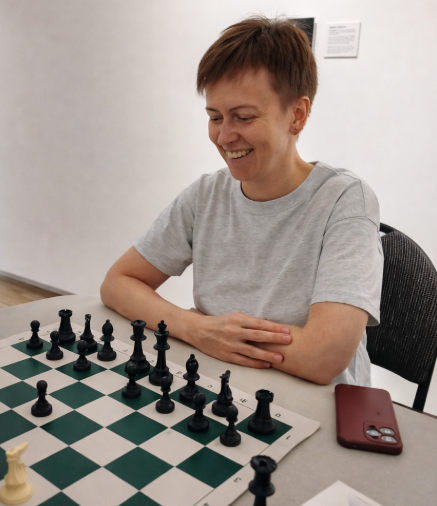 WGM Anna Burtasova playing a casual game at the Annex Chess Club (photo - author)
Interview with WGM Anna Burtasova
Hi Anna, can you tell me a little bit about yourself and about the Toronto Women's Chess Club?
Sure. My name is Anna Burtasova, I'm a Woman Grandmaster (WGM), I originally come from Russia. In 2018 I moved to Canada, and by that point I was already retired from playing competitive chess, but I've worked in chess my whole life, so I've been doing broadcasts, I've been doing journalism a lot, and I've been working in the PR team of FIDE. Yeah, so when I came to Canada, and to Toronto specifically, I started to, of course, explore the chess scene here. For the first few years I was just looking around, and I was amazed actually to see how many chess clubs are here in Toronto. And the Annex Chess Club is one of the main clubs here in the centre of the city, and then I got to know the management of the club, and we talked a lot about how women are underrepresented in chess.
So many male players, not so many girls and women, so we decided to try and do something to encourage more women to come to the club, and this is how this Toronto Women's Chess Club came about. Yeah, so now for a couple of years already, normally every second Monday of the month, because the Toronto clubs are working this way, The Annex Chess Club is every Monday, then there are some other clubs every Tuesday, the others every Wednesday, you know, it's just how it works here because of the renting spaces thing. So normally every second Monday of the month we are gathering here in the Annex Chess Club in the centre of Toronto to play chess, to learn chess, to have fun, just to encourage each other.
Now my mailing list where I put all the girls and women who ever came to the club to remind them about our meetings is already nearing 70 entries, which I think is quite a lot. Of course not everybody is coming every time, but people, they come and then they might not come for a few months, but then they come back again, so they return, and I think as long as they keep their interest, and as you saw today, they bring more friends, it's all good. I'm happy to see this, that we have constantly a dozen people every time, and sometimes more.
Yes, also the club started to hold Toronto Women's Championships, but before there was less representation, it was very difficult to find people to play, as I've heard from those who tried to organise it. I think in recent years it became much better, and I'm very happy to see this tendency. I will see in the next room that we have quite a few players playing, fighting for the title, for the prestigious title of Toronto Women's Champion. That's amazing, I think it's nice to have on your roster.
How many people would enter the Toronto Women's Championship?
A few years ago it would be just a few, sometimes they didn't even hold it, because they couldn't find enough players. Now I'm not sure exactly how many are this year, but I would say probably 15 or something, maybe more. I'm not sure, let's see. I was so preoccupied with my, as I said, I just gave birth three months ago with my second child, so I've been preoccupied with that, and I was not following too much, I guess. I like how it's developing, and of course my dream would be to see one day 50% women, in chess clubs.
I think it's super ambitious, but hopefully (it will not happen quick also, I understand that.) But hopefully in some, not 10 years, maybe 20 years, this is where we will get. As a person who is working with women in chess, you probably know that the recent studies show that around 15% of all, not studies actually, it's just statistics, around 15% of all rated chess players are women, only 15% at the moment. And this is the all-time high. If you look at 70s, 80s, then there were just one, two, I don't know how many. Single figures. Yeah, for sure. Now it's like 15, and I think it's getting more and more, and now the effect of Queen's Gambit kind of faded, I think, but we still see more women coming. So it means that there are other factors that are playing into it, and hopefully our efforts are also one of the factors.
So yeah, it's getting better, I think. It's not so quick as I would want it to be, but also, okay, let's be realistic. It's a slow process, and we just need to be really, like, we shouldn't stop.
We just need to be persistent. Yeah, so that's what I'm trying to do.
 Casual play after the lecture from WGM Anna Burtasova (photo - author)
That's brilliant! And have you got any particular success stories from the Women's Chess Club, or is there anything that you were really encouraged by? Can you think of anyone who it's really impacted their life or their chess life?
I hope that it impacts the life of those who come here, just in a way that they have a great time, and they find some new friends, some new place to socialise, and a great environment. If it's the case, for me, that would be already enough. Because, of course, if you want to have some really strong sports results, you need to train much more than once a month. So this is just more just to bring new people to the game and to keep them.
But there are two stories that I want to tell you. So first one is not exactly, like, I have nothing to do with it, but just once we had a girl who came to the club. Her name is WCM Ashley [Qian]. And she played, I played a few games with her, and I just thought, wow, she's incredibly talented. I think she was maybe, like, eight at the time. So it was already a couple of years back. And she actually fought for the first place in the recent Canadian Women's Championship. So she's, like, really progressing like crazy in these two years. She progressed so much. And I'm just happy that because of the club, I got to know her and played with her. And at that moment, I remember I was thinking, wow, if I had more time, because at the time I was just working in FIDE full time. I was super busy with everything. And I thought if I had more time, I would just be so happy. And I would feel so privileged if I were her coach, you know. But I couldn't, like, they were asking me if I generally take students or not. But at the time, it was impossible. But I was just happy to get to know her for this. And I wish her all success. She's amazing. I hope that she will be one of the brightest stars in Canada.
But the best story that I like is that we have an elderly lady that is coming to work. She was not here today, but she comes almost every time. And she was really discouraged that she was losing all the games. She likes chess. She started playing chess to help her brain working, you know, to train her brain. She read that chess prevents Alzheimer and such diseases.
And it's true, actually. There are such scientific researches that prove that chess really does prevent these things. It's like you're training for your brain. You train your muscles, you also need to train your brain. You know, create new connections and everything. But she was really unhappy that she was losing all the games. She was training, she was trying to understand chess to improve, but still she was losing all the games. She was playing in some tournaments. And then one day she came here and actually she told us that she won a game. Like in a recent tournament. I felt so happy for her and we were all so happy for her. And I just felt this kind of connection between all of us that we were really so happy for her and supported her so much.
And I think she didn't quit also because of us partly. Because we were trying to encourage her all the time. Please don't quit, you will win your game one day. Just keep on going and so on. And this is another thing that just inspires me in this story is that we all kind of came together as our small club to support her. I hope she felt the support. And finally she did it.
That's a really lovely story.
Yeah, and these things for me, that is what is important for this club. These small things. They might be small, but they are heartwarming and they are what I like to see.
Sure, it makes it worthwhile.
Yeah, for sure. For me at least for sure. These human connections and human touch that you try to help people find something good in chess beyond just competition.
That's brilliant. Thank you so much!
Female players at the meetup
During the Lichess public meetup on the Sunday, I had the opportunity to meet a couple of strong female players, WCM Lily Zhou, and WCM Olena Kucherenko. There were around six female players in total out of 64 in the tournament, which would be in line with expectations.
 WCM Lily Zhou, who finished 3rd at the Lichess public meetup blitz tournament. (photo - author)
Lily finished third only behind FM Koosha Jaferian and CM Geordie Darraugh, showing that women players can compete with the best given the opportunity. The Toronto Women's Chess Club endeavours to encourage and support women's chess to enable such opportunities and success.

WCM Olena Kucherenko (right), whom I also had the pleasure to meet at the Lichess public meetup blitz tournament. Olena placed 11th overall, and is an online chess coach. (photo - author)
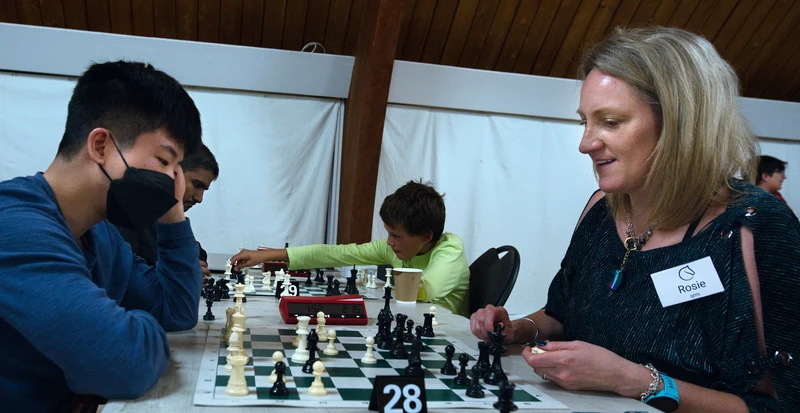
Doing my best for the women by beating 1700 FIDE-rated Leo Kim at the public meetup blitz tournament. (photo credit - John Upper)
WGM Anna Burtasova
WGM Anna Burtasova is a Russian-born Canadian chess player. She gained her WGM title in 2009 and has been a key figure in recent years in managing the online presence and communications of FIDE, the International Chess Federation. She has has worked as a social media manager, press officer, and communicator for FIDE, managing social media, covering major events like the Candidates Tournament, and acting as a press officer for world championship events. In November 2024, she curated a digital exhibition by FIDE and Google called "Beyond The Board".
The Toronto Women's Chess club meets every second Monday of the month at the Annex Chess Club in Toronto. For more information check out the links below:
Links
WGM Anna Burtasova FIDE profile
Annex Chess Club
Lichess Toronto Meetup Blog
Lichess Meetup Tournament Broadcast
Digital Exhibition
Beyond the board: A virtual exhibition by FIDE and Google
WGM Anna Burtasova (Wikipedia)
2025 Toronto Women's Championships (Closed) Results
My Ultimate Guide to Chess960 by NM visualdennis
You may also like
 thibault
How I started building Lichess
I get this question sometimes. How did you decide to make a chess server? The truth is, I didn't. Lichess
Lichess: End of Year Update 2025
Is it just us, or has this year flown by? As we say goodbye to 2025 and enter 2026, let's look back … QueenRosieMary
Breaking The Silence Online
In this blog I share some of my experiences with online harassment as a female chess player. What is… CM HGabor
How titled players lie to you
This post is a word of warning for the average club player. As the chess world is becoming increasin… QueenRosieMary
You can run, but should you hide?
Being unexpectedly thrust into the limelight was a defining and challenging moment in my time on Lic… QueenRosieMary